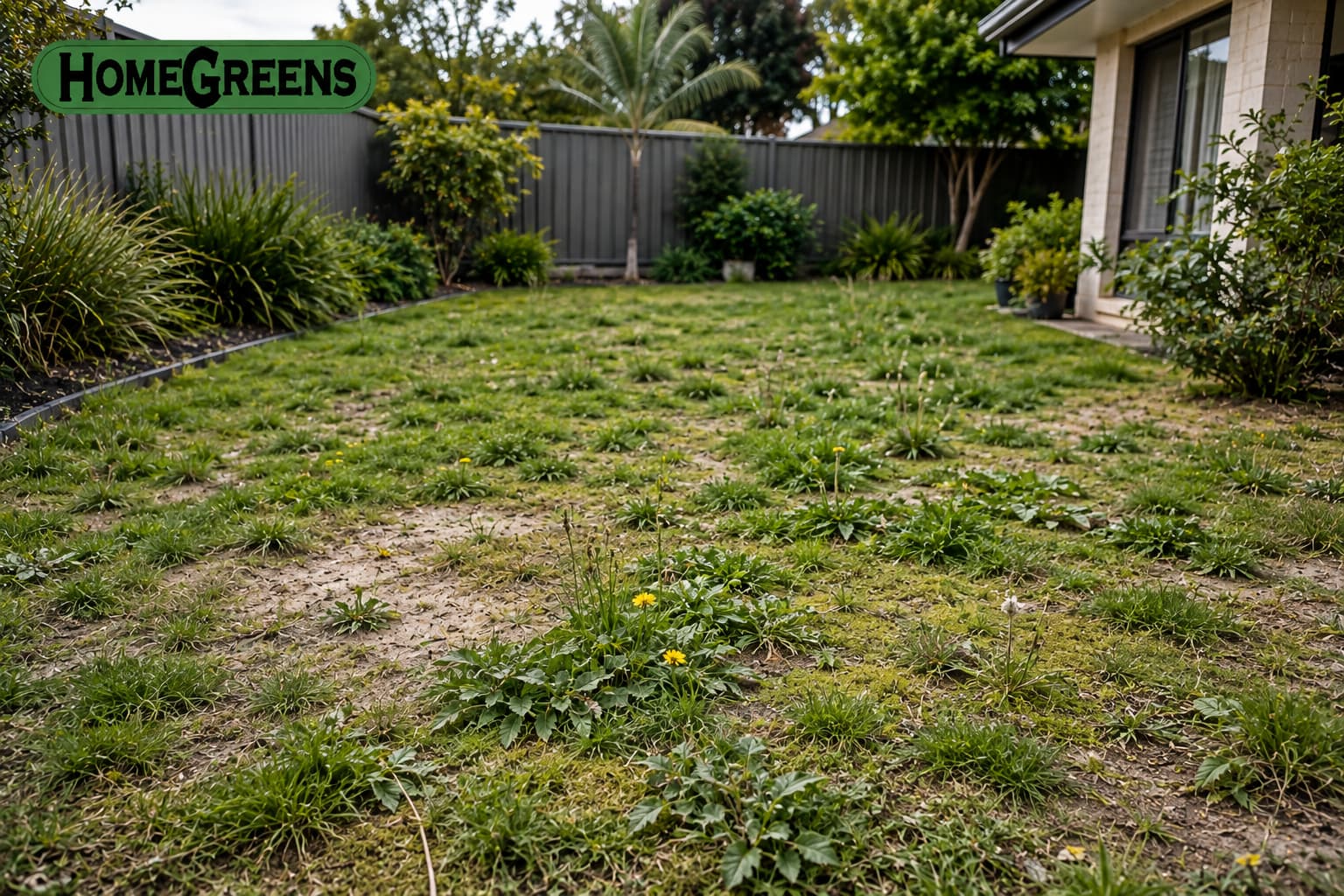
Alexander Heights Lawn Care: Fix a Weedy, Patchy Lawn
Your lawn doesn't have to be completely dead to be a problem.
Sometimes it starts with a few weeds.
Then the grass becomes thinner.
A couple of bare patches appear.
Water seems to disappear into the soil.
Before long, your lawn looks more like a collection of green and brown patches than a healthy backyard.
If that's happening to your property, simply mowing more often may not solve the problem.
A weedy, patchy lawn usually needs the underlying cause addressed — not just the visible weeds removed.
For homeowners looking for Alexander Heights lawn care, the good news is that many struggling lawns can be improved with the right combination of mowing, weed management, fertilising, aeration, verti-mowing and ongoing maintenance.
HomeGreens provides lawn-care services in Alexander Heights, including mowing, verti-mowing, aeration, fertilising and weed-control support.
If your lawn keeps getting worse despite regular mowing, contact HomeGreens for a lawn-care estimate.
Why Is My Alexander Heights Lawn Patchy and Full of Weeds?

A patchy lawn isn't caused by weeds alone.
Weeds often take advantage of areas where the grass is already weak.
Common causes include:
Poor or uneven irrigation
Sandy or water-repellent soil
Compaction
Excessive thatch
Incorrect mowing
Low nutrient availability
Heavy foot traffic
Seasonal stress
Insufficient sunlight
Existing bare areas
Poor lawn maintenance
This creates a cycle:
Weak grass → bare soil → weeds establish → less healthy turf → more bare soil.
Breaking that cycle is the key.
1. Don't Just Kill the Weeds — Find Out Why They're Winning
One of the biggest mistakes homeowners make is treating every weed problem as a weed problem.
Imagine removing all the weeds today.
If the underlying lawn remains thin, what happens next?
More weeds can simply move into the empty spaces.
Perth lawn specialists commonly identify problems such as poor irrigation coverage, hydrophobic soil, pests, disease and seasonal stress as causes of struggling lawns.
So before reaching for another weed treatment, inspect the lawn.
Ask yourself:
Is the grass growing thickly?
If not, weeds have more room to establish.
Is water penetrating the soil?
If not, roots may be struggling.
Does the lawn feel hard underfoot?
Compaction could be limiting root development.
Is there a thick layer of dead material beneath the grass?
Excessive thatch may be interfering with water and nutrients.
Is the lawn being cut correctly?
Poor mowing practices can place additional stress on already weak turf.
2. Alexander Heights Soil Can Be Part of the Problem
Soil is easy to overlook because you mostly see the grass.
But the condition underneath your lawn determines how effectively roots can access water, oxygen and nutrients.
HomeGreens' Alexander Heights service page specifically highlights the local challenge of sandy, hydrophobic soils.
When soil becomes water-repellent, irrigation may not spread evenly through the root zone.
You might notice:
Water running off
Dry patches returning
Grass looking stressed despite irrigation
Uneven lawn colour
Weeds appearing in weak areas
This is why watering more isn't always the answer.
The objective is to get water where the roots actually need it.
3. Check Your Irrigation Before Blaming the Lawn
A sprinkler system can be running while your lawn is still under-watered.
A blocked sprinkler.
A damaged nozzle.
Poor coverage.
Low pressure.
Incorrect sprinkler positioning.
Any of these can create dry areas.
A simple way to investigate is to compare water distribution across different parts of the lawn.
If one section receives substantially less water than another, you've found a potential reason for the patchiness.
Don't make this mistake:
Brown grass → increase irrigation time → water continues missing the affected area.
More irrigation doesn't necessarily mean better irrigation.
If your lawn repeatedly develops the same dry patches, professional lawn assessment can be worthwhile.
4. Compacted Soil Can Create Thin, Weak Grass
Another common problem is compaction.
Your lawn may receive regular mowing and watering, but if the soil is compacted, roots can struggle to access the resources they need.
Compaction can develop from:
Foot traffic
Children playing
Pets
Outdoor furniture
Repeated mowing
Heavy use of particular areas
A compacted lawn may become thin and slow to recover.
This is where aeration can help.
Aeration creates openings in the soil, helping improve movement of water, air and nutrients toward the root zone.
HomeGreens provides professional lawn aeration services across Perth's Northern Suburbs, including Alexander Heights.
If your lawn looks watered but still struggles to grow strongly, ask HomeGreens whether aeration could be appropriate.
5. Could Excessive Thatch Be Making Your Lawn Patchy?
Look closely at the base of the grass.
If you find a thick layer of dead stems and organic material sitting between the green blades and soil, the lawn may have excessive thatch.
Too much thatch can interfere with the movement of water and nutrients.
This is where verti-mowing may be appropriate.
Verti-mowing cuts through excessive thatch and removes accumulated surface material, allowing the lawn to recover more effectively. Perth verti-mowing specialists commonly recommend it for lawns suffering from thatch-related problems.
HomeGreens also positions verti-mowing as a lawn-rejuvenation service.
You can learn more about professional verti-mowing in Perth before deciding whether your lawn needs it.
Important:
Verti-mowing isn't automatically required for every patchy lawn.
The correct treatment depends on why the lawn is patchy in the first place.
6. Your Mowing Routine Matters More Than You Think
Mowing isn't just about making the lawn look shorter.
It affects lawn health.
Cutting too aggressively can stress the grass.
Allowing it to become excessively long before mowing can also create problems.
HomeGreens recommends regular mowing as part of maintaining a healthier, better-looking lawn, with its broader service offering combining mowing with other lawn-care treatments where needed.
For many Perth lawns, regular maintenance during active growth is more effective than allowing the lawn to become severely overgrown and then cutting it heavily.
A better approach:
Regular mowing → consistent grass height → less stress → stronger-looking turf → easier weed management.
If you simply don't have time to keep up with it, HomeGreens offers regular and one-off lawn mowing services across Perth.
7. Fertilising Can Help — But It Isn't a Magic Fix
A thin lawn can sometimes benefit from appropriate fertilising.
But fertiliser shouldn't be used as a substitute for fixing poor soil, irrigation or mowing.
Think about it this way:
You can't solve a root-zone problem simply by feeding the leaves.
If the lawn is compacted, water-repellent or suffering from excessive thatch, those problems may need to be addressed first.
HomeGreens provides professional lawn fertilising across Perth and positions fertilising as part of broader lawn health rather than simply cosmetic greening.
8. When Should You Consider Professional Weed Control?
If you have a few isolated weeds, hand removal may be practical.
But professional help becomes more attractive when:
Weeds are spreading rapidly
Weeds return after removal
The lawn is heavily infested
You can't identify the weed
The grass is already weak
You are concerned about applying products incorrectly
Different weeds can require different approaches.
For example, Perth has seasonal weed problems, with winter rainfall triggering germination of many weeds. Local weed-management programs commonly combine cultural, mechanical and targeted chemical approaches rather than relying on one method.
HomeGreens includes weed control and lawn clean-ups within its lawn-care offering.
If weeds are taking over your Alexander Heights lawn, contact HomeGreens rather than letting the problem spread.
The 5-Step Alexander Heights Lawn Recovery Plan
If your lawn is currently weedy and patchy, don't try ten different treatments at once.
Start logically.
Step 1 — Identify the problem
Look at the soil, irrigation, mowing and grass condition.
Step 2 — Remove or control existing weeds
Deal with the current weed problem appropriately.
Step 3 — Improve the root zone
Consider aeration or soil treatment where conditions warrant it.
Step 4 — Address excessive thatch
Verti-mowing may be appropriate if thatch is restricting lawn performance.
Step 5 — Maintain the recovery
Regular mowing, appropriate fertilising, irrigation and weed management help prevent the lawn from returning to its previous condition.
The goal isn't simply to make your lawn look better this weekend.
It's to make it easier to keep healthy.
How HomeGreens Can Help Your Alexander Heights Lawn
HomeGreens has a dedicated Alexander Heights lawn-care service and specifically highlights the challenges of local sandy, hydrophobic soils.
Its current service offering includes:
Lawn mowing
Verti-mowing
Aeration
Fertilising
Weed control
Lawn clean-ups
That means you don't necessarily need to organise several different contractors to address different lawn problems.
Depending on the lawn's condition, a practical maintenance program could combine several services.
For example:
Patchy + compacted lawn
→ Mowing + aeration + appropriate fertilising
Patchy + excessive thatch
→ Verti-mowing + fertilising + ongoing mowing
Weedy + thin lawn
→ Weed control + lawn maintenance + appropriate nutrition
Overgrown + neglected lawn
→ One-off mowing + clean-up + ongoing maintenance
The exact combination should depend on the lawn rather than forcing every customer into the same treatment.
Why Choose HomeGreens for Alexander Heights Lawn Care?
HomeGreens describes itself as Perth-based and locally operated, with experience across WA grass types and Northern Suburbs conditions.
Its broader services cover mowing, verti-mowing, aeration, fertilising and weed control.
The biggest advantage for a homeowner isn't simply having someone cut the grass.
It's having a service that can recognise when mowing isn't the only problem.
If your lawn looks good immediately after mowing but becomes patchy again a few days later, that's the point where broader lawn care becomes worth considering.
FAQs
How do I fix a patchy lawn in Alexander Heights?
Start by identifying why the lawn is patchy. Check irrigation, soil condition, compaction, thatch, mowing practices, nutrition and weeds. The correct treatment depends on the underlying cause.
Why do weeds keep coming back after I remove them?
Weeds often return when the underlying turf remains thin or bare. Improving lawn density and addressing soil, irrigation and maintenance problems can help reduce the conditions that allow weeds to establish.
Can aeration help a patchy lawn?
Aeration can help where soil compaction is restricting movement of water, air and nutrients around the roots.
What is verti-mowing?
Verti-mowing removes excessive thatch and surface vegetation, helping improve access to the soil and supporting lawn recovery.
Does HomeGreens provide weed control in Alexander Heights?
Yes. HomeGreens includes weed control and yard-care services within its broader lawn-care offering and lists Alexander Heights as a service area.
Can HomeGreens provide regular lawn mowing?
Yes. HomeGreens offers regular weekly or fortnightly mowing as well as one-off mowing services.
Ready to Fix Your Weedy, Patchy Lawn?
A lawn doesn't become healthy simply because the weeds disappear.
The grass underneath needs to become strong enough to compete.
If your Alexander Heights lawn is:
Patchy
Thin
Weed-infested
Spongy
Dry
Overgrown
Or simply becoming difficult to manage
it may be time to stop treating individual symptoms and look at the lawn as a whole.
You can also contact HomeGreens to request a service. The current booking form allows customers to select lawn mowing, verti-mowing, aerating, weed control and fertilising.
For the full range of treatments, visit HomeGreens lawn-care services.
Don't just mow over the problem. Fix the lawn underneath it.
