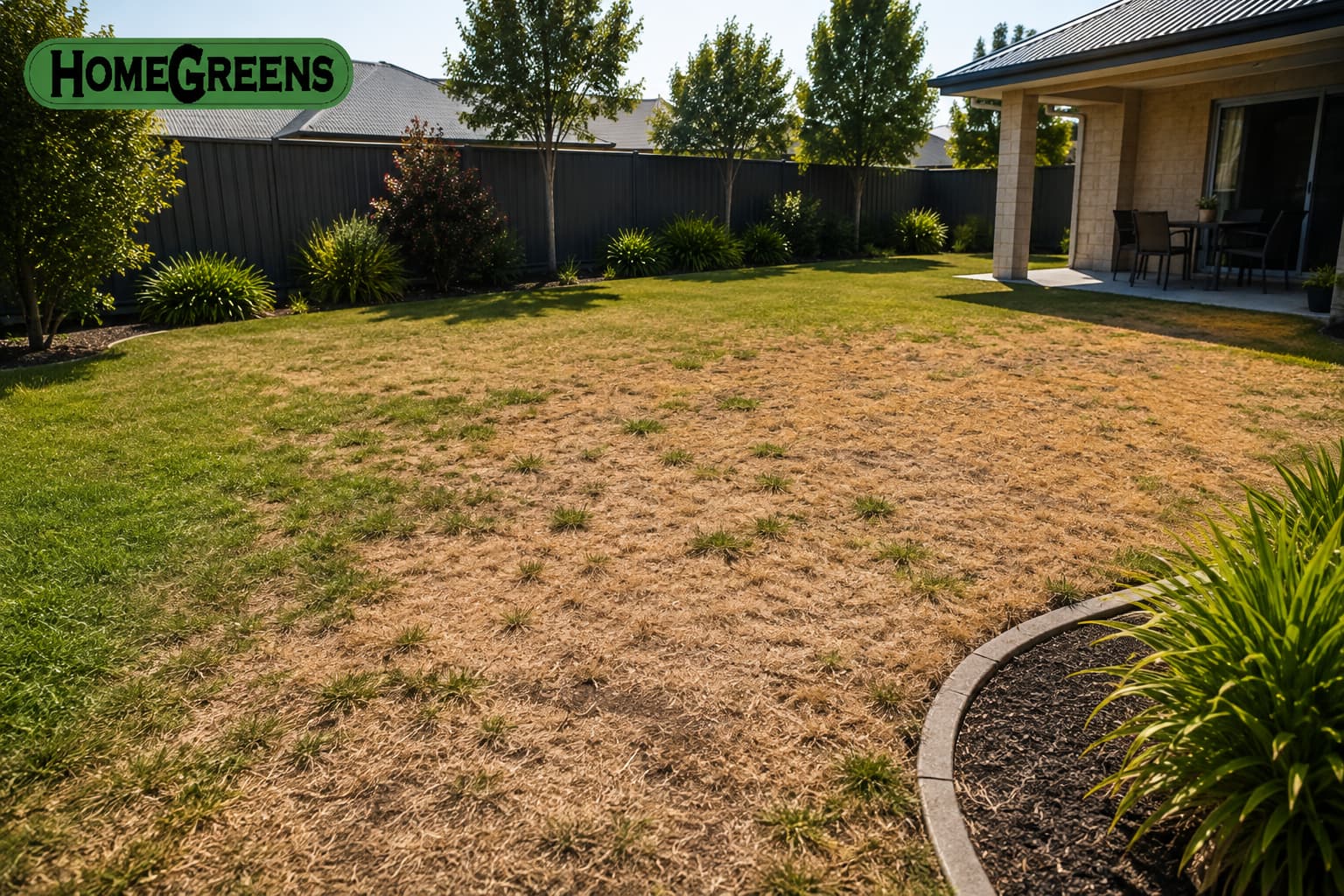
Ellenbrook Lawn Care: Why Your Grass Keeps Turning Brown
You water your lawn.
You mow it.
You may even fertilise it.
Yet somehow, it still turns brown.
And the frustrating part?
You can have one section of the lawn looking green while another section only a few metres away looks dry, thin and lifeless.
If that sounds familiar, the problem may not simply be that your lawn needs more water.
For Perth lawns, brown grass can be linked to poor irrigation coverage, water-repellent sandy soil, heat stress, compaction, excessive thatch, incorrect mowing, pests or other lawn-health problems. Water Corporation specifically notes that brown lawns in WA are often associated with unhealthy or hydrophobic soil, while uneven irrigation can create dry brown patches.
That means the solution isn't always:
“Turn the sprinklers on for longer.”
Sometimes, you need to find out why the lawn isn't using the water properly in the first place.
If your Ellenbrook lawn keeps turning brown despite regular watering, contact HomeGreens for a lawn-care estimate.
Why Does Grass Turn Brown in Ellenbrook?

There isn't one universal cause.
A brown lawn is a symptom.
The real job is identifying what's causing the symptom.
The most common possibilities include:
Insufficient or uneven watering
Water-repellent sandy soil
Extreme summer heat
Soil compaction
Excessive thatch
Incorrect mowing
Nutrient deficiencies
Pests or lawn disease
Seasonal dormancy
The location of the brown patches can provide clues.
Brown everywhere?
Think about overall heat stress, irrigation and seasonal conditions.
Brown patches between green areas?
Check sprinkler coverage and soil water penetration.
Brown around heavily used areas?
Compaction may be contributing.
Brown lawn with a thick layer underneath the grass?
Excessive thatch could be restricting water and nutrients.
Brown patches appearing suddenly?
Pests, disease or irrigation failure may need investigation.
1. Your Ellenbrook Lawn May Not Be Getting Water Evenly
This is one of the first things to check.
Your irrigation system can appear to be working while still delivering very different amounts of water across the lawn.
A blocked sprinkler.
A misaligned sprinkler.
Low water pressure.
Incorrect sprinkler spacing.
A damaged nozzle.
Any of these can create dry areas.
Water Corporation recommends using catch cups to check whether irrigation is distributing water evenly. Their brown-lawn guidance specifically identifies blocked or misaligned sprinklers and unsuitable sprinkler heads as common causes of dry patches.
Try this simple test
Place several flat containers across different parts of the lawn.
Run the irrigation.
Compare how much water each container collects.
If one area receives significantly less water, you may have found part of the problem.
Don't automatically increase the irrigation time until you've checked distribution.
More water won't fix a sprinkler that isn't reaching the right area.
2. Perth's Sandy Soil Can Make Brown Patches Worse
This is a major consideration for Perth lawns.
Sandy soils drain quickly, and some Perth soils can become hydrophobic, meaning they repel water rather than allowing it to penetrate evenly.
Water Corporation explains that hydrophobic WA sands can prevent water from reaching the root zone properly.
That creates a frustrating situation:
You water the lawn → water runs away or channels through the soil → roots remain dry → grass turns brown.
This is why simply watering more isn't necessarily the answer.
A quality soil-wetting program can help water penetrate more evenly.
HomeGreens' current Perth lawn-care service specifically includes lawn care for Perth conditions, along with mowing, aeration, verti-mowing, weed control and clean-ups.
If your Ellenbrook lawn keeps developing the same dry patches, professional assessment can help identify whether water penetration is part of the problem.
3. Summer Heat Can Push a Lawn Beyond Its Limits
Perth summers can be tough on turf.
During periods of extreme heat, grass can lose moisture faster than the root system can replace it.
The lawn may become:
Pale green
Yellow
Brown
Thin
Brittle
Patchy
Water Corporation recommends protecting lawns from extreme summer heat through appropriate nutrition, aeration and waterwise irrigation practices.
But don't panic when the lawn changes colour.
Brown doesn't automatically mean dead.
Water Corporation notes that a brown lawn may still be salvageable if the plant remains alive at the crown.
That's important.
Before replacing the entire lawn, determine whether the grass is actually dead.
4. Your Mowing Technique Could Be Adding Stress
Mowing is essential.
But mowing incorrectly can make a stressed lawn worse.
Cutting too much grass at once can place additional pressure on the plant.
Water Corporation recommends adjusting mowing frequency and height according to grass type and season and warns that mowing too short can stress the lawn and increase susceptibility to weeds and disease.
Watch for these mowing mistakes:
Cutting the lawn excessively short
Removing too much blade at once
Mowing an already heat-stressed lawn aggressively
Using blunt mower blades
Allowing the lawn to become excessively long before cutting
Water Corporation also recommends sharp mower blades because blunt blades can damage grass and increase moisture loss.
If your lawn is already badly stressed, don't assume a very short cut will make it look healthier.
It can have the opposite effect.
5. Compacted Soil Can Stop Your Lawn From Recovering
Another overlooked cause is soil compaction.
Imagine trying to grow healthy grass when the root zone can't easily access:
Air
Water
Nutrients
Heavy foot traffic, repeated use and soil conditions can contribute to compaction.
The result may be:
Thin grass
Slow growth
Poor water penetration
Patchy areas
Increased stress
This is where aeration can help.
Aeration creates openings that improve the movement of air and water into the root zone.
Water Corporation recommends aeration as part of brown-lawn recovery and notes that it can improve water penetration and help wetting agents and other treatments reach the soil.
HomeGreens offers professional lawn aeration in Perth as part of its lawn-care services.
6. Excessive Thatch Could Be Blocking the Lawn
Look closely underneath the grass.
Do you see a thick layer of dead stems and organic material between the green blades and soil?
That's thatch.
A small amount can be normal.
Too much can interfere with water, air and nutrients reaching the root zone.
Water Corporation recommends dethatching/verti-mowing as part of lawn recovery where excessive thatch is present.
HomeGreens' verti-mowing service is designed to help remove excessive thatch and improve access to the root zone.
Think of it this way:
If water can't reach the roots efficiently, adding more water isn't necessarily solving the problem.
You need to improve the pathway between the water and the roots.
7. Fertiliser Isn't Always the First Answer
A brown lawn can tempt homeowners to reach for fertiliser immediately.
But that's not always the best first move.
If the lawn is:
Severely heat-stressed
Dry
Compacted
Water-repellent
Poorly irrigated
then fertiliser alone won't solve the underlying issue.
In fact, fertilising a severely stressed lawn without addressing the underlying problem can be counterproductive.
A better approach is:
Diagnose → improve soil/water access → support recovery → fertilise appropriately.
Water Corporation recommends appropriate nutrition as part of broader lawn recovery rather than treating fertiliser as the only solution.
8. Could Pests or Disease Be Causing Brown Patches?
Not every brown patch is a watering problem.
If your irrigation appears normal but the lawn suddenly develops irregular brown areas, investigate further.
Possible causes can include:
Lawn insects
Root-feeding pests
Fungal problems
Severe thatch
Physical damage
Animal activity
One Perth lawn-care provider currently identifies lawn grubs and fungal disease among potential causes of irregular brown patches.
A useful warning sign
If the brown patches are:
Appearing rapidly
Irregularly shaped
Spreading despite adequate watering
Accompanied by unusual grass texture
Returning in exactly the same areas
don't keep adding water and fertiliser blindly.
Get the lawn assessed.
How to Tell If Your Ellenbrook Lawn Is Dead or Dormant
This is one of the most important questions homeowners ask.
A brown lawn isn't necessarily dead.
Water Corporation recommends examining the crown at the base of the grass. A pale or off-white crown can indicate the plant is still alive and potentially recoverable.
Look for:
Signs it may recover
Grass crowns remain alive
Some green growth remains
Brown areas aren't completely bare
Roots remain established
The lawn responds when moisture conditions improve
Signs the damage may be severe
Completely bare soil
No living crown
Extensive dead areas
Persistent deterioration despite correcting watering and soil conditions
If large areas are genuinely dead, renovation or replacement may eventually be more appropriate than repeatedly treating the symptoms.
What Should You Do When Your Ellenbrook Lawn Turns Brown?
Instead of immediately increasing watering, work through this checklist.
Step 1: Check irrigation
Are all sprinklers working?
Step 2: Check soil moisture
Is the soil actually receiving and holding water?
Step 3: Check mowing
Has the lawn been cut too short?
Step 4: Look for compaction
Does the soil feel hard?
Step 5: Check for thatch
Is there a thick layer between the grass and soil?
Step 6: Inspect for pests
Are there signs of insect activity or unusual damage?
Step 7: Consider seasonal stress
Could the lawn simply be responding to extreme heat or winter dormancy?
Step 8: Get professional help if the cause isn't obvious
That's often faster than spending money on products that don't address the real problem.
How HomeGreens Can Help Your Ellenbrook Lawn
HomeGreens currently lists Ellenbrook among its Perth lawn-care service areas. Its local lawn-care offering includes mowing and edging, aeration and verti-mowing, weed control and lawn clean-ups.
The company also describes itself as Perth-based and locally operated, with experience with WA grass types and local growing conditions.
Depending on the condition of your lawn, HomeGreens can help with:
Regular lawn mowing
Lawn edging
Aeration
Verti-mowing
Fertilising
Weed control
Lawn clean-ups
You can explore the complete HomeGreens lawn-care services to see how the different services fit together.
For homeowners who simply need ongoing mowing, the Perth lawn mowing service offers weekly or fortnightly mowing, one-off mowing and edge trimming/clean-up options.
Don't Keep Fighting the Same Brown Patches
This is perhaps the biggest lesson.
If the same brown patch keeps returning, the problem probably isn't going to disappear simply because you water more.
You need to identify the underlying cause.
It could be irrigation.
It could be soil.
It could be mowing.
It could be compaction.
It could be thatch.
Or it could be something affecting the lawn's roots.
Fixing the cause is what gives you a better chance of fixing the lawn.
If you're tired of looking at the same brown patches every summer, contact HomeGreens and discuss your lawn.
Ellenbrook Lawn Care: Seasonal Brown-Lawn Prevention Plan
Water Corporation notes that Perth lawns require considerably less irrigation during winter and that many lawns may only need mowing around once a month depending on growth.
The key is seasonal adjustment, not treating your lawn exactly the same way all year.
FAQs
Why does my Ellenbrook lawn keep turning brown?
Common causes include uneven irrigation, water-repellent sandy soil, heat stress, compaction, excessive thatch, incorrect mowing and potentially pests or disease.
Should I water my brown lawn more?
Not automatically. First check whether the water is reaching the affected area and penetrating the soil. Increasing irrigation won't fix blocked sprinklers or hydrophobic soil.
Can a brown lawn recover?
Yes, a brown lawn isn't necessarily dead. If the grass crowns and roots remain alive, appropriate watering, soil improvement and lawn care may allow recovery.
Can aeration help a brown lawn?
Aeration can improve the movement of air and water into compacted soil and can support other lawn treatments.
Does HomeGreens provide lawn care in Ellenbrook?
Yes. HomeGreens currently lists Ellenbrook as one of its Perth lawn-care service areas.
Does HomeGreens offer more than lawn mowing?
Yes. Current services include mowing and edging, aeration, verti-mowing, weed control and lawn clean-ups, with fertilising also available through its broader lawn-care offering.
Ready to Fix Your Brown Ellenbrook Lawn?
You don't have to accept a brown lawn as the price of living in Perth.
And you don't need to keep buying lawn products hoping the next one will finally solve the problem.
Find the cause. Fix the underlying issue. Then maintain the lawn properly.
If your Ellenbrook lawn is repeatedly turning brown, HomeGreens can help you work out the next practical step.
Call HomeGreens on 0411 429 249 for a lawn-care estimate.
Or contact HomeGreens to discuss your lawn and request a quote. The current contact page provides an enquiry/booking form where homeowners can select relevant lawn-care services.
You can also see examples of the company's work in the HomeGreens lawn-care gallery.
